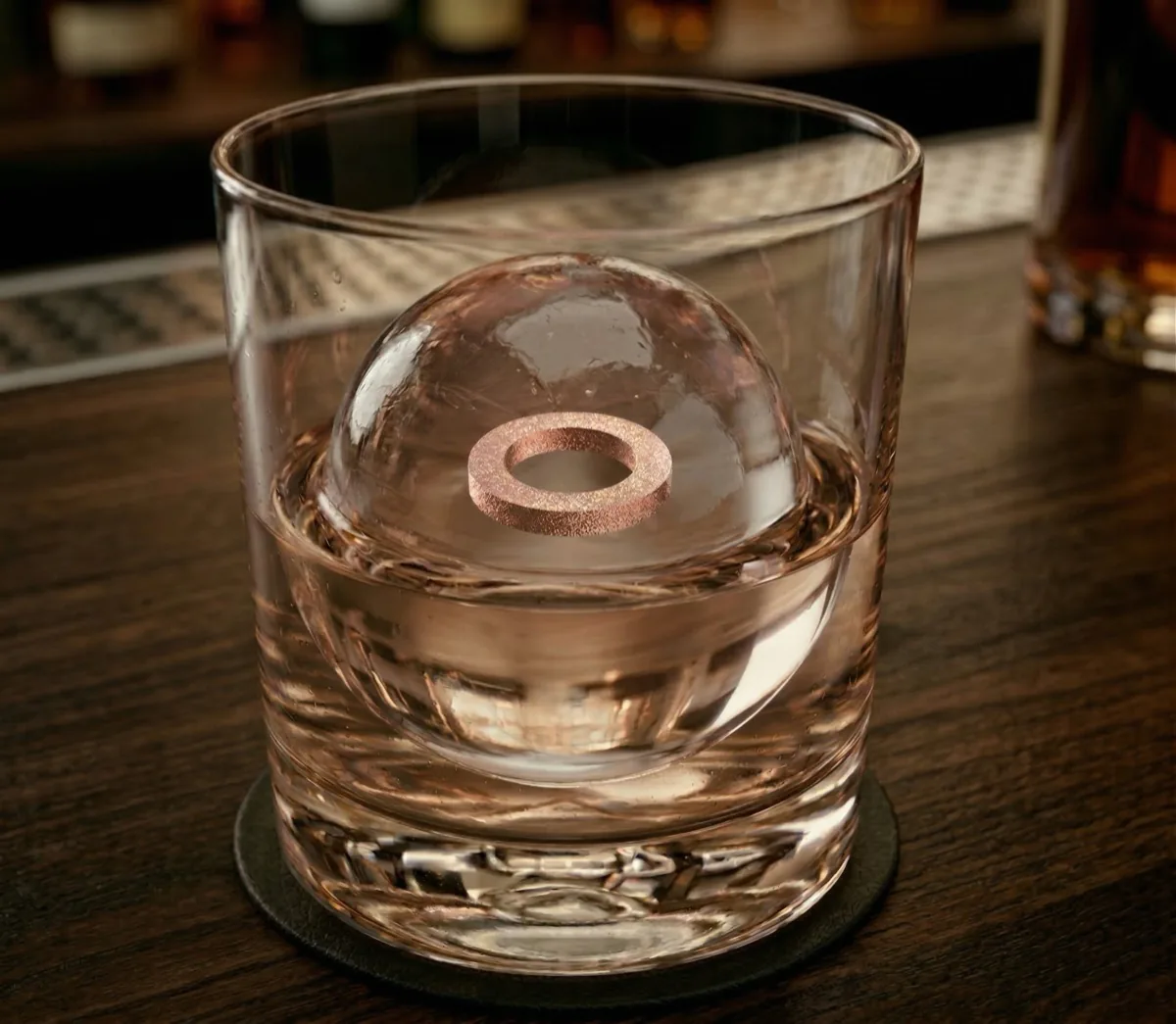
The halo generates more questions than any other part of the product. Is it a flaw? Is it marketing? Did we forget to filter the water? I wanted one journal entry I could point trade partners to when their staff get asked at the rail, because the answer is neither obvious nor short.
I will not claim the halo doubles your check average or replaces a well-run beverage program. It is a visual signature, not a shortcut. This article exists because your team will get questions, and they deserve an honest script. If you want anonymous clear ice with no story, other suppliers do that well. If you want to understand what guests are actually reacting to when they tilt the glass, read on.
Every Aurasphere piece carries a frosted halo suspended at the geometric center. In the glass it reads before the first sip. It gives the serve a focal point that guests photograph without being prompted. That reaction is what we designed for. Whether it leads to a second round depends on everything else you do right.
What people think they are seeing
Social comments often call the halo "the cloud inside the clear ice" or ask whether it is trapped air from a bad freeze. Bartenders who have only worked with machine cubes assume any white interior means impurity. Both instincts come from experience with bad ice, not from what we are doing.
Accidental cloudiness is irregular: streaks, cracks, opaque cores that look like frozen foam. The Aurasphere halo is symmetric, centred, and consistent piece to piece. Rosé Pearl carries a rose-gold shimmer in that ring. Aurum Royale suspends 23-karat gold at the core. Nimbus stays frosted white. The geometry repeats because production repeats, not because nature got lucky in one tray.
Why the inside, not the outside
The halo is jewellery frozen into the glass, not a logo lasered onto the surface. External stamps and embossed marks on clear ice look clever in a photo and vanish during the first minutes of melt. We wanted a signature that stays visible while the guest is still drinking. That meant engineering a ring at the geometric centre: a frosted white band, a rose-gold shimmer, or 23-karat gold suspended in the core depending on collection.
That is what sets us apart from the clear-ice makers producing excellent anonymous spheres in cities around the world. We respect their craft. Our obsession was different: make the inside of the ice worth looking at, because ice already occupies so much of the glass and nobody had treated that interior space as a canvas.
What the halo actually is
The halo is a frozen ring placed at the core on purpose, separate from the optically clear mass around it. Clarity and signature follow different process controls. We reject air and minerals from the outer volume, then introduce the ring as a deliberate visual anchor that survives the pour.
That is why we bother with clear ice at all. Not to win a transparency contest. A cloudy sphere with a centred ring would technically work, but it would look muddled and the halo would never pop the way it does through a clean surround. Clarity is the stage lighting. The ring is the performance.
That separation matters for taste. The clear ice around it leaves nothing of its own in the glass. The halo is not a dirty centre melting first and ruining the pour. It is a stable visual element held in suspension so the guest sees intent before they taste proof.
“On a busy floor, the halo does work your team does not have to. The glass already looks considered before garnish or pour.”
Why we did not hide it
We could have pursued anonymous clarity. Many premium ice brands do, and they do it well. We chose a centred ring because operators told us consistency of presentation was harder than consistency of freeze, and because the original dream was never "make clear ice." It was "make ice you can recognise in the glass." The clear mass exists so that recognition happens instantly: tilt the glass, the ring reads, the drink feels more considered than the menu price alone would suggest.
Trade partners also told us guests remember the ring. Not the brand name on a napkin. The moment they tilted the glass toward the light. That is why lighted coasters and menu placement guidance show up in our trade toolkit. The halo gives guests something worth noticing. What they do with that moment is up to the rest of your serve.
What the halo is not
It is not a flavour additive. It is not a reason to sell ice as a line-item upsell. We advise pricing Aurasphere into the drink because the moment you itemize ice on the bill, guests judge it as a commodity instead of part of the serve.
It is also not proof of mineral contamination. If you hear that from a supplier protecting their cube contract, ask them to explain directional freezing versus trapped air. Then ask why their cube cloud melts unevenly when you pour over it. I still welcome that conversation in person.
