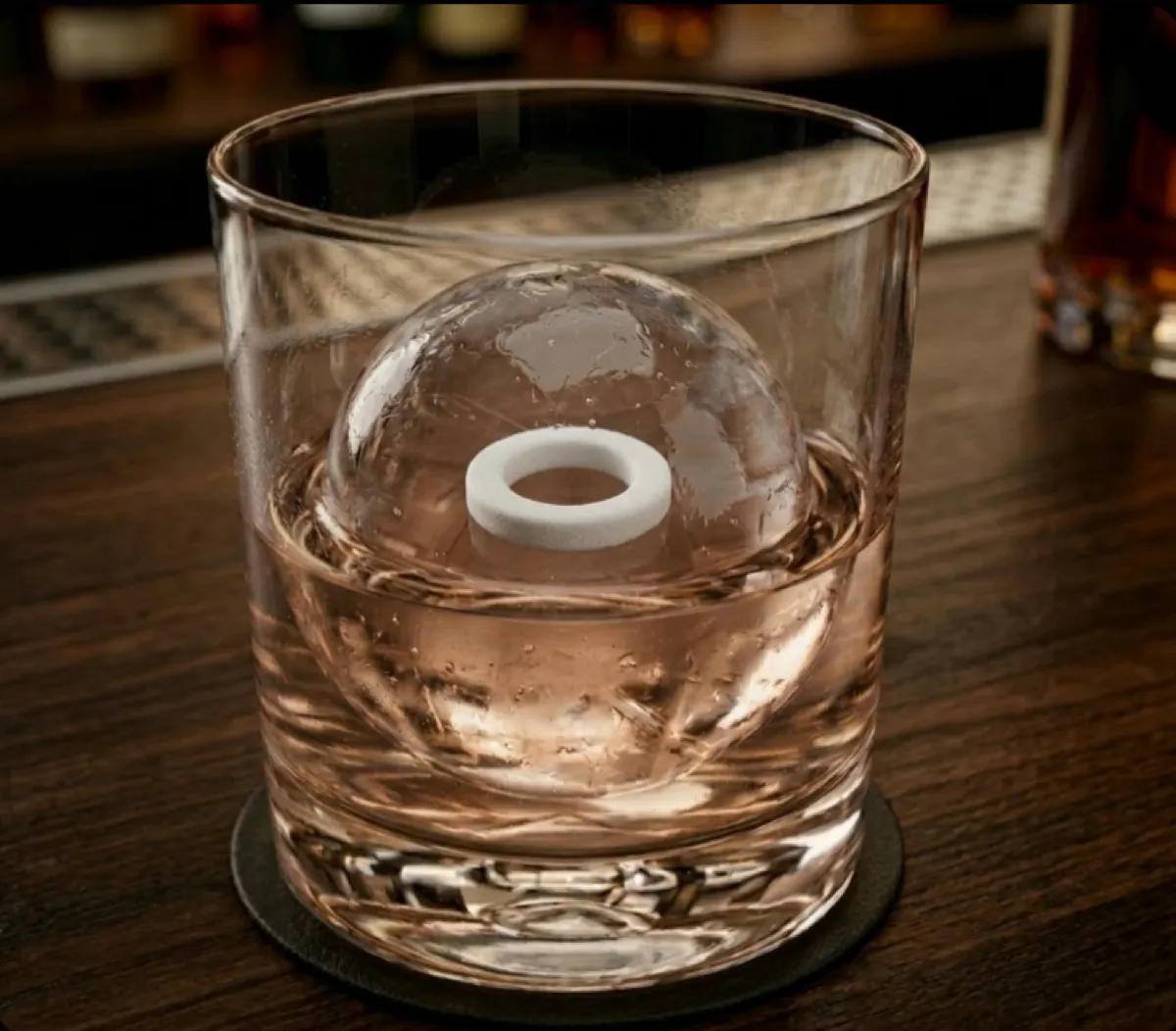
"It melts the same." "It is just cosmetic." "Our guests cannot tell." Those are the kinds of things venues say when we talk about cloudy ice, so let me answer the question first.
Cloudiness is trapped air. When water freezes fast from the outside in, dissolved air, minerals and micro-fractures get pushed toward the middle and locked there. That white core is not attractive, and it is a structural weak point. It melts unevenly, breaks apart under thermal shock, and can carry off-flavours into the glass. You taste it in the last third of the drink, usually right when the guest is deciding whether to order another.
I will not tell you clear ice alone transforms a mediocre programme. It will not fix a bad spec. But if you serve spirits that cost more than the hourly wage of the person pouring them, the mechanism is worth four minutes.
The forum myths
Boil the water twice. Buy a directional-freezing tray. Use distilled water. Every bartender forum has these threads, and each tip contains a grain of truth. We know, because we tried them all.
In 2025 I ran consumer trays in a chest freezer for six weeks. My early experiments failed repeatedly: my ice imploded, wetting my entire freezer, because I had yet to learn what directional freezing was. We almost quit more than once.
Boiling helps at home. A tray helps at a dinner party. Neither delivers identical 60mm spheres on a Friday night when three stations are deep in service. That is the production reality the forums skip.
Why it matters beyond looks
Guests notice clarity when it is gone, even if they never name it. They call the drink "watery" or "off" sooner than your spec intended. The physics: cloudy ice hides extra surface area inside its fractures and air pockets, so it melts in bursts rather than steadily. On a spirits-led serve, that early burst flattens aroma before the first conversation is over. Your staff compensate by pouring colder or stirring longer: labour and product cost you are not counting.
What directional freezing does
Freeze water from one direction, slowly, and the freeze front pushes air and minerals ahead of it; the last material to solidify is the material you remove. It needs time, space, and control over the temperature gradient. It cannot be rushed without paying for it somewhere in the glass.
Credit where it is owed: most of the world learned that principle from Camper English, the San Francisco drinks writer who named "directional freezing" on his blog Alcademics back in 2009, after months of methodical freezer experiments. He is, more than anyone, the reason clear ice went from a banquet-hall novelty to something bartenders take for granted today. We arrived at the same physics the hard way, imploded freezers and all, before we found his work. He got there first and explained it best; what we added was the precision to make it the same every time.
That is how the clear mass of every Aurasphere is made.
Try this tonight
Pull two cubes from your machine and hold them to the light. Then pour spirit over them and watch where the melt starts. It is the quickest way to see what cloudy ice does to a drink.
Clear ice is the starting point. Once the cloudiness is gone, you have room to add something on purpose: a deliberate point of beauty at the centre of the ice.